
What does logging into OKX actually unlock for a U.S.-based trader, and which part of the platform deserves attention first: the centralized derivatives engine, the Web3 wallet, or the staking & yield layer? That sharp question reframes the usual product-tour into a practical decision: different OKX components solve different problems, and each brings specific trade-offs in custody, counterparty exposure, liquidity, and operational risk. The right choice depends on whether you prize leverage and short-term market exposure, long-term yield and token access, or non‑custodial Web3 utility.
This article compares those alternatives side-by-side, surfaces common myths, explains mechanisms (how leverage, cold storage, and self-custody actually work), and gives clear takeaways a U.S. trader can use when deciding how to log in and move funds. I’ll assume you already know terms like “perpetual swap” or “seed phrase”; the emphasis is on translating platform features into practical trade-offs and checklists you can act on immediately.
Overview: three linked ecosystems and the core trade-offs
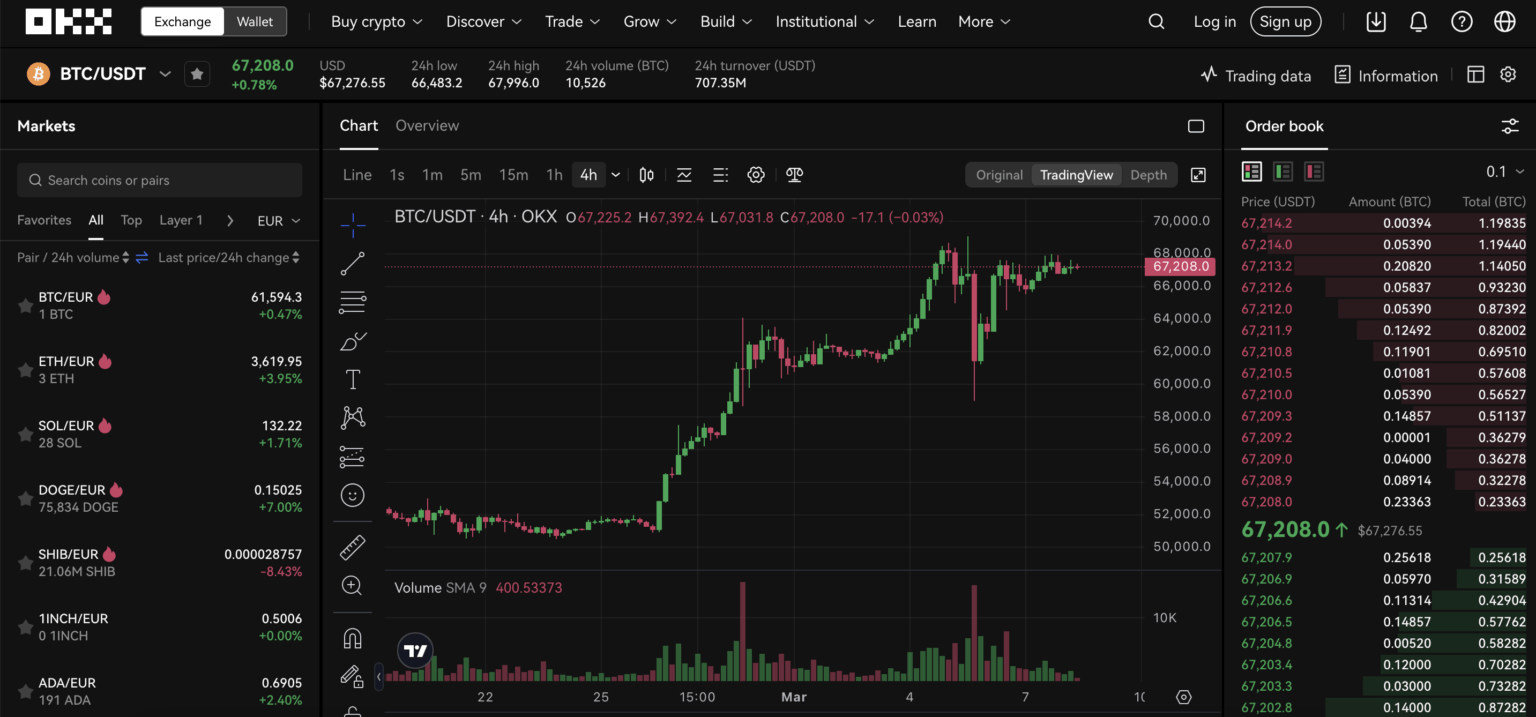
OKX consolidates three broad capabilities in one product: a centralized exchange (CEX) with spot, margin, and derivatives; a non-custodial Web3 wallet; and yield services (staking, DeFi aggregation, NFT marketplace). Mechanically, those components differ along two axes that matter to traders: custody (who controls private keys) and leverage/liquidity (how exposed you are to market moves and counterparty solvency).
Custody: the CEX holds assets on behalf of users and claims to keep over 95% of those assets in air-gapped cold wallets with multi-signature withdrawal controls. The Web3 wallet hands custody to you via a seed phrase and supports hardware signers like Ledger and Trezor. Liquidity & leverage: the CEX aggregates orderbook liquidity, offers TradingView charting, and supports margin up to 10x and futures leverage up to 125x on select instruments. The non-custodial side trades mostly on DEXs where slippage and fragmented liquidity are the norm.
Side-by-side: OKX futures (CEX) vs OKX Web3 (self-custody)
Mechanism: How each works
OKX futures operate on a centralized matching engine. When you place a perpetual or quarterly futures order, the exchange records margin, marks positions to market using internal or external price feeds, and enforces liquidation rules. The advantage is speed, deep liquidity on large pairs, and margin tools (isolated vs cross margin). The downside is counterparty dependency: positions depend on the exchange’s risk management, insurance fund, and the correctness of liquidation processes.
In contrast, the OKX Web3 wallet is a client-side, non-custodial tool. You keep the private keys. When you interact with DeFi—swap tokens, provide liquidity, or call a yield-farming contract—transactions are signed locally and broadcast to the underlying chain. The upside is control and interoperability with many DApps and blockchains; the downside is direct exposure to smart contract risk, irreversible seed loss, and on-chain gas and slippage costs.
Liquidity, costs, and execution
For active traders focused on execution quality, the centralized futures market usually wins: orderbooks, limit orders, partial fills, and margining systems are built for high-frequency decision making. DEX-based trading through the Web3 wallet depends on liquidity pools and AMM math—large trades can suffer slippage and impermanent loss. OKX’s DEX aggregator can help route swaps more efficiently across Uniswap-style liquidity, but it cannot eliminate the fundamental liquidity constraint when a token has low total value locked.
Risk trade-offs
Centralized futures risk bundle: exchange operational risk, potential withdrawal delays, and policy-driven delistings. Recent platform housekeeping—OKX’s delisting of several spot pairs this March—illustrates routine CEX behavior: delistings tighten the tradable universe in order to protect overall market health, but they also remove on‑exchange liquidity for niche tokens. That matters if you plan to trade small-cap assets on margin: a delisting can trigger forced unwinds or transfers.
Web3 risk bundle: smart contract bugs, front-running, and self-custody failures. The wallet’s hardware integrations (Ledger/Trezor) materially reduce key-theft risk, but they do not remove protocol-level vulnerabilities. Mechanically, when you stake or deposit into a yield protocol, your funds are locked behind code whose failure modes are different—and sometimes permanent—compared with a CEX insolvency event.
Common myths vs reality
Myth: “Custodial exchanges are always unsafe; self-custody is safer.” Reality: Safety depends on threat type. For external attackers, a CEX that uses 95% cold storage and multisig is often harder to crack than an individual’s laptop. For sovereign or regulatory risks, centralized custodians can freeze assets; self-custody cannot. The right answer is often a split approach: keep trading capital on the exchange for execution and liquidity while keeping long-term holdings in a hardware-backed Web3 wallet.
Myth: “Higher leverage is a free multiplier.” Reality: Leverage changes the distribution of outcomes, not the price process. Mechanically, 125x futures amplify even small funding or basis moves into full losses. For U.S. traders who face tax and regulatory constraints, aggressive leverage also complicates record‑keeping and margin maintenance. Use leverage with explicit stop and liquidity plans; consider lower leverage for assets with higher volatility or thin orderbook depth.
Practical frameworks: which workflow to choose and when
Decision heuristic 1 — The liquidity-first day trader: Keep fiat and trading collateral on the CEX, use futures for directional trades, prefer limit orders on main pairs, run 2FA and AI-login alerts, and only use margin up to the level where a single reasonable adverse move won’t trigger liquidation.
Decision heuristic 2 — Yield-oriented holder: Move principal to the Web3 wallet or staking channels, prefer fixed-term lock-ups when yield/cost trade-offs make sense, and use auto-compounding when it measurably improves net APY after fees. Keep a small active balance on the exchange for opportunistic rebalancing.
Decision heuristic 3 — Blended operator: Use the exchange for hedging and rebalancing, and the Web3 wallet for accessing DApps and NFTs. Treat the CEX as liquid infrastructure and the wallet as long‑term custody and Web3 gateway; maintain rigorous operational separation (different passwords, separate devices where possible).
Operational checklist before logging in
For U.S. users, account setup has some mandatory steps: KYC (government ID and liveness check), mandatory 2FA, and understanding tax reporting implications. Before you log in: confirm which assets you will keep on-exchange, enable hardware wallet support for any Web3 activity, and set withdrawal whitelist rules if the platform offers them. If you use futures, test small margin positions first and make sure you understand funding rates and insurance fund mechanics.
Also: watch for delistings and product updates. Exchanges periodically prune low-liquidity pairs. A recent delisting wave removed specific spot pairs; that action is routine and intended to protect users from illiquidity, but it can disrupt strategies that rely on niche tokens being available on-exchange.
What breaks and what to watch next
Limitations and failure modes are practical: sudden liquidity drains, oracle manipulation on thinly traded assets, swap slippage when a DEX route is starved, and regulatory changes that alter deposit/withdrawal flows. Mechanistically, funding rate spikes can force mass liquidations in perpetual markets; on-chain, a single exploited contract can drain a liquidity pool irreversibly. Monitor three signals closely: orderbook depth (for your target pairs), funding rate trends (for perpetuals), and protocol audits/upgrade notices (for DeFi interactions).
Forward-looking implications (conditional): If macro volatility rises or a major stablecoin struggles, centralized derivatives platforms typically see margin demand and higher liquidations—watch insurance fund size and the exchange’s public risk disclosures. If cross-chain activity grows, OKX’s DEX aggregator and multi-chain wallet integrations will become more valuable operationally, but they also increase attack surface for bridge exploits.
Frequently asked questions
Do I need KYC to trade futures on OKX from the U.S.?
Yes. To use derivatives and many trading features, OKX requires Know Your Customer (KYC) verification that includes a government ID and a facial liveness check. This is driven by AML rules and reduces anonymous access to leveraged products; plan for identity verification before attempting to trade sizable positions.
Can I use the OKX wallet and still trade on the exchange?
Yes. The OKX ecosystem supports both centralized and non-custodial workflows. Many traders keep trading capital on the exchange for execution while storing longer-term holdings or DeFi collateral in the Web3 wallet. Use the wallet’s hardware integrations for higher security and be careful about where you paste your seed phrase.
Is 125x leverage a good idea for retail traders?
Almost never as a first choice. Mechanically, extreme leverage converts small price pencil-marks into catastrophic losses due to margining and liquidation algorithms. A more responsible rule is to size positions so that a plausible short-term volatility spike does not immediately liquidate your margin—this typically means far lower leverage for volatile altcoins than for BTC or ETH.
How does OKX prove reserves and why should I care?
OKX offers Proof of Reserves (PoR), enabling on-chain verification that deposited assets are backed. PoR increases transparency and reduces some counterparty uncertainty, but it is not a panacea: PoR shows snapshot backing, not operational liquidity or future solvency under stress scenarios.
Closing: a practical next step
If you’re ready to try OKX, a safe first step is deliberate: complete KYC, enable 2FA and login alerts, deposit a modest trading fund, and run a rehearsal trade. If you want to split custody, transfer the remainder to the Web3 wallet and secure it with a hardware device. For login and wallet setup resources, consult the official access page for step-by-step guidance at okx.
Pick a primary objective—execution, yield, or self-sovereignty—then tailor your balance between the exchange and Web3 wallet to that objective. Keep watch-lists for funding rates, delisting notices, and protocol alerts. That combination of clear goals, small rehearsals, and ongoing monitoring converts abstract features into a defensible trading plan.
 Jolancer academy and agency established in 2018 in Jordan to help in develping the Online freelancing.